
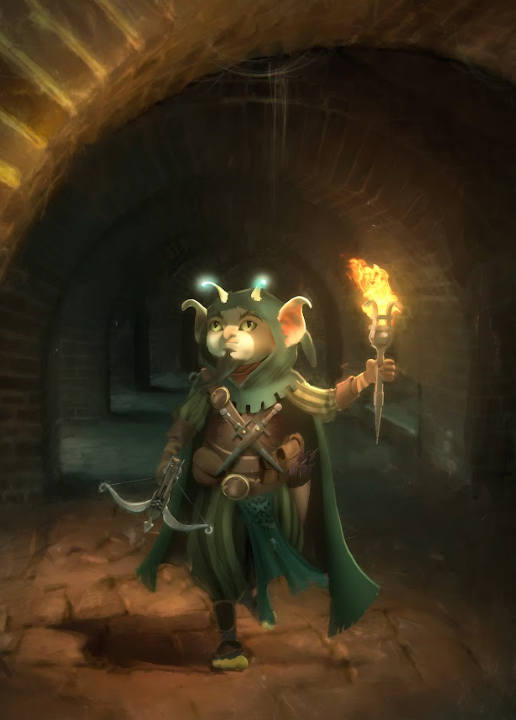
Some NPCs walk onstage and instantly feel real.
You introduce an NPC you thought was going to be a throwaway innkeeper, and somehow the party becomes obsessed with him. Two sessions later, they are willing to burn down a guild hall to protect Gregor “Soup Ladle” Fen. Meanwhile, the mysterious masked spymaster with the tragic backstory, coded journal, and carefully planted plot hooks gets a polite nod and the conversational energy of a rotten turnip.
Players don’t always latch onto the people you expect them to. Sometimes they adopt a goblin you invented in six seconds. Sometimes they ignore the queen. Sometimes they will spend forty minutes interrogating a dockworker whose only original purpose was to say, “Yeah, I saw a boat.”
That unpredictability is part of the fun, but it also means GMs need a fast, reliable way to make NPCs feel alive. Not elaborate. Not overbuilt. Alive.
That is where the three V’s come in: Voice, Verb, Vulnerability.
If you can give an NPC a distinct way of speaking, a clear way of acting, and one visible point of humanity, you can make them feel real enough for players to care about, bounce off of, distrust, love, mock, protect, or accidentally marry.
You do not need a ten-page character dossier. You need three good hooks.
Voice: How They Sound in the World
Let’s start with the obvious one.
When most GMs think about memorable NPCs, they think about voice first. That makes sense. Voice is often the first thing players notice. It’s the wrapper. The flavor. The thing that lets the table instantly recognize who is talking before you even say their name.
Now, “voice” does not mean you have to be a one-person fantasy radio drama with twelve flawless accents locked and loaded. If you can do accents and enjoy them, great. Have a blast. But accents are optional. Distinction is what matters.
A voice can be a rhythm. A habit. A vocabulary choice. A level of formality. A weird obsession with certain phrases. A tendency to answer questions with questions. A merchant who talks too fast. A knight who chooses every word as if it costs money. A necromancer who sounds relentlessly cheerful about deeply upsetting things.
That is voice.
Think about how much mileage you can get out of tiny choices. The town guard captain who calls everyone “friend” can feel very different depending on whether she sounds sincere, exhausted, or one bad day away from using that word like a threat. A scholar who says “fascinating” every time something goes horribly wrong tells the table a lot in just one repeated word.
Good NPC voice is often less about performance and more about pattern.
Here is the nice part: players are incredibly generous about this. They do not need a perfect stage performance. They need something they can grab onto. If the old herbalist always speaks like she is halfway through gossip she has no business knowing, the table will remember her. If the young squire keeps trying to sound brave and keeps failing by a little, the table will remember him, too.
Voice gives the NPC shape.
It also does something important for you as the GM. It makes improvising easier. Once you know how somebody sounds, you usually start to know how they think. And once you know how they think, they stop feeling like a cardboard quest dispenser and start feeling like a person who might say something surprising.
Verb: What They Do
This is the one people skip, and it’s maybe the most useful of the bunch.
If voice is how an NPC sounds, a verb is what they do.
What is this person doing when the players meet them? What is their energy in motion?
Are they pacing? Praying? Sharpening a knife? Rearranging papers that are already neat? Avoiding eye contact? Lying badly? Cleaning blood off a gauntlet while insisting everything is fine? Trying to impress somebody? Trying to leave? Trying to get through the day without screaming?
A good verb makes an NPC feel present.
This matters because tabletop scenes are dynamic. The players are not reading a character summary. They are encountering someone in a moment. If that moment has motion, intention, and direction, the NPC enters the scene with momentum.
“The barkeep is friendly” is fine.
“The barkeep is polishing the same mug so hard you think it might vanish, while keeping one eye on the front door” is better.
Now we have something. Now the players are already asking questions.
Verb helps with first impressions because players are detectives, whether they mean to be or not. They are always reading the room for signals. What is this person up to? What are they worried about? What are they hiding? What kind of scene are we in right now?
If you give them an action, they have something to react to.
This is especially handy for NPCs who are only going to get a few minutes of screen time. You may not have time for a rich emotional arc with the ferryman, the junior clerk, or the goblin lookout. But if the ferryman keeps glancing nervously at the fog bank, the junior clerk is discreetly trying to cover a coffee stain on a royal decree, and the goblin lookout is attempting to look terrifying while standing on a crate that is clearly too wobbly, those characters already feel much more vivid.
Verb is also your best friend when you need to distinguish NPCs quickly.
A lot of GMs accidentally create a world full of people who stand there and deliver information. Same posture. Same energy. Same invisible hands. The more you think in verbs, the more your cast starts to move differently. One NPC hovers. Another prowls. Another fusses. Another slouches. Another barrels into the room like subtlety personally insulted them.
That kind of physical and behavioral texture does a lot of work.
Vulnerability: The Crack That Lets the Light In
Now we get to the magic.
Voice makes an NPC recognizable. Verbs make them active. Vulnerability makes them memorable.
When I say vulnerability, I don’t necessarily mean weakness in the combat sense. I mean the point where the armor parts are just enough for the players to glimpse the person underneath.
Maybe the terrifying mercenary captain cannot read and hates being handed written orders in public. Maybe the smug wizard is desperate for approval from a mentor who is never going to give it. Maybe the jolly tavern owner keeps overfeeding adventurers because his daughter used to leave on the road hungry. Maybe the crime boss has an obvious soft spot for stray animals and becomes visibly tense when one wanders too close to a meeting.
That is the stuff players hook into.
Not because they are kind, though sometimes they are. But vulnerability makes an NPC feel like a person instead of a function. It gives the players leverage, empathy, suspicion, curiosity, or all four at once.
And importantly, vulnerability does not have to be a tragic monologue.
Please, for the love of dice, do not make every NPC sound like they are auditioning for a prestige drama about grief in the kingdom of rain. A vulnerability can be tiny. Embarrassing. Sweet. Petty. Weird. Human.
A blacksmith who is embarrassed by how much he loves terrible poetry.
A priest who is brave in public and scared of silence.
A bounty hunter who acts ice cold until somebody mentions her horse.
A lich who is genuinely furious that nobody appreciates good penmanship anymore.
That last one is ridiculous, yes. It’s also exactly the kind of thing players remember for years.
Vulnerability is often what transforms “that guy from town” into “our guy from town.”
Why the Three V’s Work So Well at the Table
The beauty of this approach is speed.
You don’t need to stop your session and draft a character essay every time the players unexpectedly decide the stable hand matters now. You just need three choices.
-
How does this person sound?
-
What are they doing?
-
Where is the soft spot?
That is enough to get you through an introduction, a conversation, and often a whole relationship arc if the players take interest.
For example:
The apothecary speaks in clipped, suspicious little bursts. That is voice.
She keeps labeling and relabeling bottles even while talking to the party. That is a verb.
She is clearly terrified that one wrong mistake will hurt someone again. That is vulnerability.
Boom. You have somebody.
Or:
The mercenary lieutenant laughs too loudly at his own jokes. Voice.
He is always adjusting his gloves like he is getting ready for a fight that has not started yet. Verb.
He desperately wants people to think he earned his rank. Vulnerability.
Again, somebody.
You don’t need more unless the table asks for more.
Don’t Use All Three at Maximum Volume
One useful trick is not making every NPC equally vivid in the same way.
Some characters deserve a huge voice and a subtle vulnerability. Some need a strong verb because they are only around briefly. Some are quiet and ordinary until the vulnerability hits, and suddenly the table is locked in. Variety helps.
If everybody has a huge gimmicky voice, the campaign starts to feel like a cartoon tavern at midnight. Fun for a while, exhausting by session twelve. If everybody has crushing emotional vulnerability, the world gets weirdly soggy. If everybody is all verb and no inner life, the cast may feel clever but thin.
Mix and match.
The old knight might have a very plain voice, a strong verb, and a devastating vulnerability. The goblin fence might have a loud voice, a twitchy verb, and a very small vulnerability that only shows up later. The queen might begin as all poise and ritual, then reveal vulnerability only after the party has known her for ten sessions.
That slow reveal can be delicious.
A Quick Test for NPC Stickiness
If you want to know whether an NPC is ready for the table, try this:
Can you picture how they enter a room?
Can you hear one sentence they would say?
Can you name one thing they don’t want anyone to notice?
If yes, you are probably good.
That is the secret. Memorable NPCs are not always the most detailed ones. They are the ones who give players something to grab onto. A voice they can quote. A behavior they can picture. A hidden softness they can discover.
That is what makes an NPC feel like more than furniture.
So the next time your players suddenly decide the random locksmith, exhausted courier, suspicious fishmonger, or deeply unqualified cultist is now extremely important, don’t panic. You don’t need a novel. You just need the three V’s.
Give them a voice.
Give them a verb.
Give them a vulnerability.
And then watch your table do what tables do best: fall completely in love with the one goblin accountant you invented by accident.
Your Turn!
Let us know how you create NPCs in the comments below.
TTRPG Campaigns Made for Game Masters
Running a TTRPG campaign takes creativity, flexibility, and a surprising amount of preparation. Maps need to be ready. NPCs need personalities. Locations need history. Encounters need stakes. And, inevitably, your players will become fascinated with the one character you thought they'd ignore.
Gooey Cube builds campaigns with those moments in mind.
Our TTRPG campaign resources give Game Masters richly developed locations, memorable NPCs, visual references, maps, encounters, and story material that can help bring a session to life. Instead of handing you a few pages of adventure text and leaving the rest up to you, Gooey Cube gives you a deeper collection of tools to draw from throughout the campaign.
That means more options when players wander away from the expected path and more opportunities to make the world feel like it existed long before the party arrived.







0 comments